

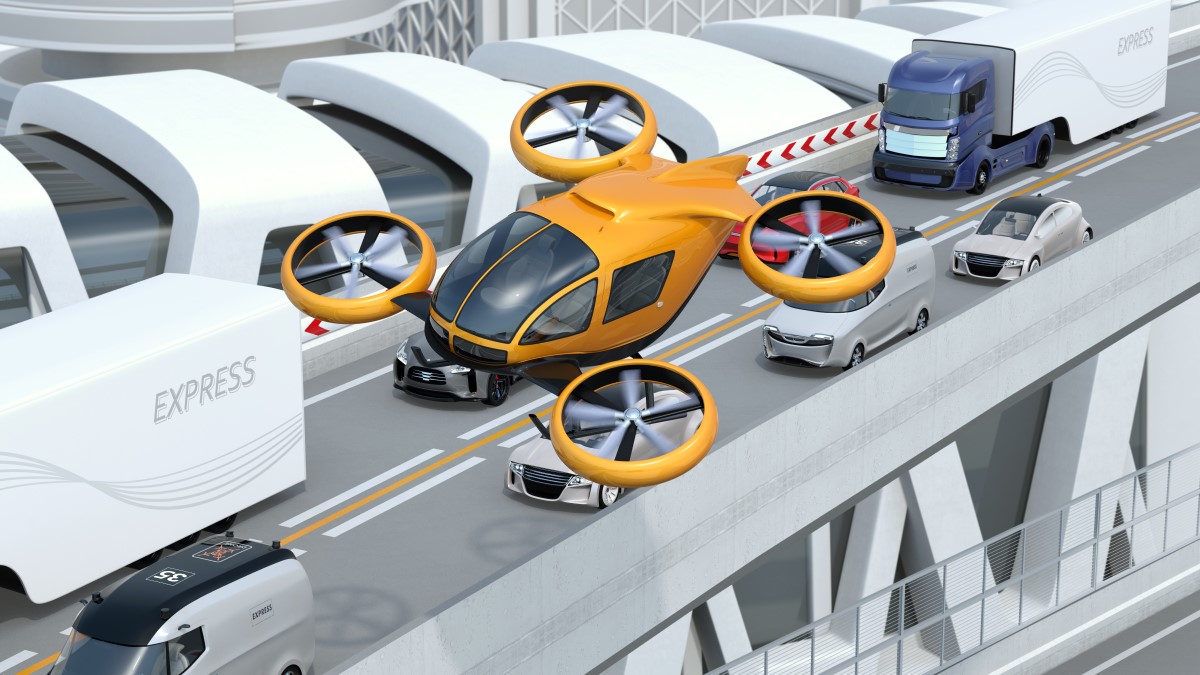
We are at the doorstep of a new era in the history of aviation. Flying taxis are getting closer to disrupt the way we move promising a more time and space efficient way of transportation. Population growth and shift from rural to the urban areas leaves the cities at a more tangled state on the ground with exponentially increasing transportation problems. It is time to utilize the airspace above us to enhance our quality of living and relieve our environment.
As appealing as it is to actualize a world just like in the 1960s animated show The Jetsons, the technology needs to prove itself to be advantageous over the existing modes of transportation. Urban Air Mobility (UAM), one of the commonly used term for this new mode of transportation, is preparing to take the stage with many long and near term promises. Let’s take a look at a couple of those.
Efficiency
Residents of populated cities are overwhelmed with high traffic volumes and low flow rates that get worse day by day. Building more roads or extending existing ones do not look like it solves the problem. UAM brings the third dimension into play and avoids traffic congestion by flying over it. Moreover, covering longer distances with higher speed vehicles is significantly more efficient, giving back commuters their time wasted on the road. Avoiding congested traffic and reducing commute time will probably be one of the major attraction points for UAM.
Safety
Hundreds of design concepts were generated up to date, some were able to move to design phase while others could go further and currently are working for certification. These electric or hybrid powered vehicles often referred as eVTOLs (electric Vertical Take Off and Landing) have to prove themselves to be safe and secure before anything else. Safety is always priority in aerospace industry that all aircraft and their components are designed at an extremely low rate of probability of failure and go under rigorous testing to comply with stringent regulations. Autonomy, power redundancy, advanced detect-and avoid (DAA) are some of the key attributes eVTOL vehicles are planned to be furnished with to safely operate.
Flexibility
Whether it is on-demand service like an air taxi or scheduled on predetermined routes like public transportation, ease of access will be a key to market buy in. Demand will shape the form of operations and transform them in time. On-demand service is rather new to air travel where today travelers make their plans around flight schedules. On-demand service reverses this structure in a way that air service fits into passenger’s schedule. It may be considered revolutionary in that sense however not an easy task to accomplish. UAM is more likely to be a part of a system that combines several modes of transportation during a single trip rather than being a stand-alone solution. It might be the airport shuttle from your hotel to catch a long range flight or the air taxi to the neighbor state picking you up at a convenient location by the subway station. The key to success lies in allowing the passenger to configure their end-to-end trip through a user friendly interface utilizing real time information and the convenience of the trip itself accounting for the number of stops, vehicle switches, and wait times between transfers.
Reduced costs
If you consider that such air service is offered today by helicopters and only available to a small market at the very high end, low cost appears to be a long term goal. Low cost and scalability are highly dependent on one another. Once UAM regulations and infrastructure is established, automation is complete, and more vehicles are available for and gets adopted by masses, costs that are initially high may be expected to go down. It should be noted that this new industry is currently supported by investments only. Further advancement of the technology and development of transportation networks of eVTOLs greatly depend on the public adoption of the technology. Reducing costs to a level that could compete with ground transportation is a major objective to be achieved.
To be continued… What will this novel mode of transportation change for communities?
Featured Image Source: Chesky/Shutterstock.com

 akustikone.com